Ahmed Sinai's psychological decline
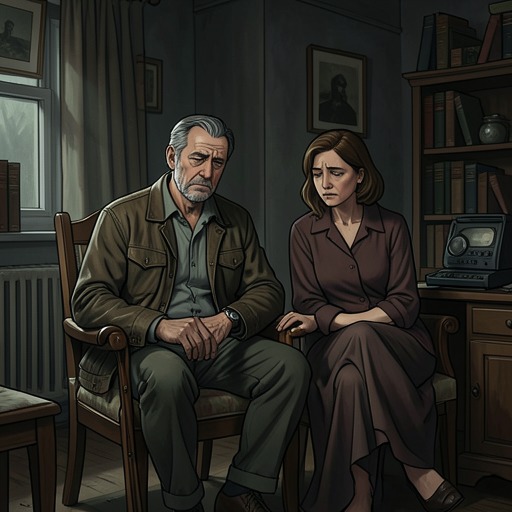
Midnight's ChildrenAhmed Sinai’s psychological decline follows the death of Doctor Narlikar and the collapse of their tetrapod land-reclamation scheme. A project that had served Ahmed as a substitute for intimacy and family connection disappears with its partner, and Ahmed responds not by rebuilding those ties but by withdrawing from them. His increasing isolation, abstraction, drinking, and eventual belief in a curse he had invented turn private disappointment into a damaging break with ordinary life.
The failed tetrapod dream
By the closing days of 1956, the plan to reclaim land from the sea with thousands of concrete tetrapods seemed close to realization. Ahmed had learned from the earlier financial freeze: he spent cautiously, kept himself in the background, and ensured that his name appeared on no documents. The project had acquired an intensely personal function as well as a commercial one. In the aftermath of the freeze, which had denied him sexual activity, the scheme became a kind of substitute for it.
The idea had once joined Ahmed and Doctor Narlikar in a shared toast to their concrete undertaking. Narlikar’s death, however, left no record of Ahmed’s involvement, and the partnership’s apparent promise ended without a secure public trace of Ahmed’s role. The narrator presents this loss as the trigger for a long decline: after the disaster, Ahmed is swallowed by a deterioration from which he does not emerge until late in his life, when he finally falls in love with his wife.
Withdrawal from family life
The change first appears in the routines of the household. After nearly ten years of good-humored breakfasts, Ahmed becomes increasingly absent from the table. He avoids giving Amina money directly, though his carelessly discarded clothes contain cash that she can retrieve to support the household. He also stops telling the children bedtime stories regularly. When he does tell them, the familiar princes, goblins, flying horses, and magical adventures come out in an unconvincing, perfunctory manner; the stories retain their old subjects, but lose the imaginative force that once animated them.
Ahmed withdraws more completely after Doctor Narlikar’s death and the end of the tetrapod dream. He rises before dawn and locks himself in his downstairs office with whichever secretary is then employed. The two evergreen trees he planted to commemorate Saleem and Brass Monkey have grown tall enough to block much of the daylight from the office windows, a detail that places his seclusion within the family home while also separating him from it. The family rarely dares disturb him. He refuses food from the household kitchen and instead lives on inexpensive meals and drinks brought to the office.
The narrator interprets Ahmed’s retreat as a response to the unreliability of human relationships: he appears to divest himself of connection rather than risk another dependence. His solitude is striking in the crowded setting of the family’s country, and the narrator associates the atmosphere around his office with an older sense of failure that has returned more strongly. The household sees the withdrawal in practical as well as emotional terms: Ahmed is physically present in the home, yet increasingly inaccessible to the people around him.
Speculation and the appearance of success
Ahmed converts his property into money by selling the chawls he had bought cheaply after arriving in Bombay. Those properties had helped establish the family’s fortunes; selling them frees him from business dealings with tenants in Kurla, Worli, Matunga, Mazagaon, and Mahim. In their place comes financial speculation, conducted from behind his locked office door. His telephone becomes his principal connection with the outside world, carrying instructions about shares, stocks, government bonds, and bear-market equities.
The speculation succeeds. Ahmed and the telephone take the stock exchange by storm, and he repeatedly secures favorable prices by anticipating rises and leaving before falls. The narrator likens his responsiveness to the market’s unpredictable movements to the attentiveness of a lover to a beloved’s slightest change. This apparent mastery conceals rather than reverses his decline: under the cover of growing wealth, Ahmed’s separation from reality becomes steadily worse. His worsening drinking accompanies the financial success, so prosperity is not evidence of recovery but the façade behind which his condition deteriorates.
The imagined curse and its consequences
As his secretaries leave, unable to tolerate the atmosphere of his office, Ahmed asks Mary Pereira to find a replacement. She brings her sister Alice Pereira, whose presence gives the family a view of Ahmed’s increasingly troubling behavior. Ahmed has turned to the family curse he once invented to impress William Methwold. In his altered state of mind, he seems to believe that the curse is real and that he has merely forgotten its words. He spends long hours in isolation experimenting with formulas, directing them at Sherri, the mongrel dog that had joined the family.
Sherri does not respond as Ahmed expects. The narrator describes Ahmed treating her as a test subject for his supposed curse, while Alice reports his repeated efforts to curse the animal. When Sherri remains unaffected, Ahmed orders the family into the car and drives away without letting the dog in. She chases the vehicle over a long distance and dies during the pursuit. The episode makes the consequences of Ahmed’s delusion concrete: a story he had once fabricated for social effect has become a private belief, and his effort to impose it on reality ends in the death of a family pet.
Afterward, Ahmed buys Saleem a puppy for his tenth birthday. The gesture may have come from a flicker of guilt, but the new dog also dies, and the family has no pets after that. The sequence closes on loss rather than repair: the replacement does not undo what happened to Sherri, just as Ahmed’s profitable speculation does not undo his isolation. The decline’s defining pattern is the widening gap between outward forms of compensation and the relationships and imaginative life that have been lost.